Goats are fascinating creatures, and their most eye-catching skills are excellent rock climbing, jumping and balance. I believe many people have experienced its climbing skills on the Internet before.
Their figures are found in all kinds of dangerous places in the world. Even with the pictures and the truth, it is still difficult to imagine how they crawled to these places. In addition to their bold and careful personality, this superpower of goats is mainly due to their special hooves. Goats have small hooves, and even on a small plane, they can still stand on them.
When climbing, the cushions on the soles of the goat's feet will generate great friction with the rocks, and the cushions that can be deformed will also fit into the raised rocks, making it more difficult for the goat's hooves to slide. In addition, a hard edge around the hooves will wrap the concave cushions of the goat's hooves with the raised rocks. Combined, this will create a huge grip, and the goat's hooves are locked firmly to the rock surface.
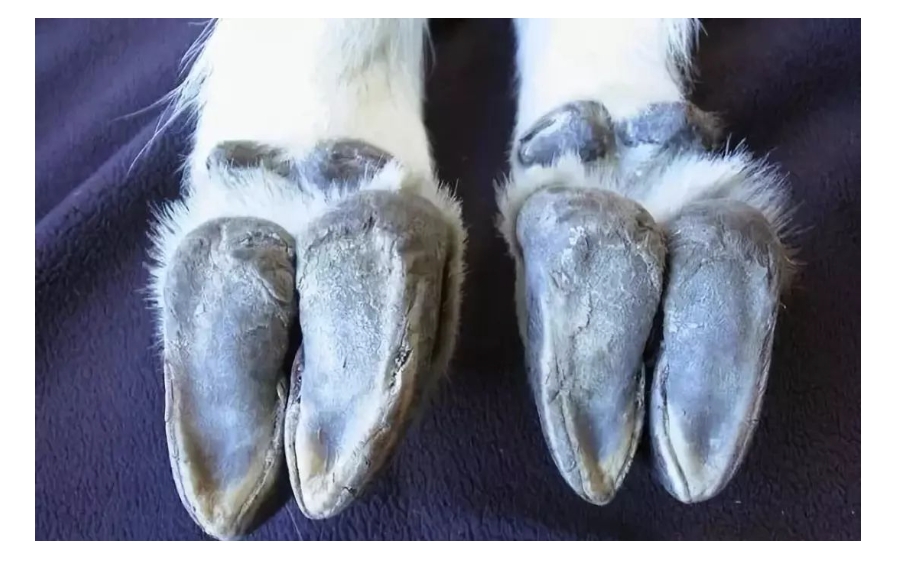
In addition, goats belong to the order of cloven hooves, and their toes are more open than other animals, so they can firmly grasp rocks. The toes can also be combined, and the forward tilt allows the toes to squeeze into small cracks.
Especially on the cliffs, the two toes that can be separated can make their footing smaller. Anywhere, as long as there is room for half of his hooves, they are likely to climb up.
Going up is easier than going down, and goats have a knack for going down. The little hooves on the back of their feet can also stick into the road and act as a brake.
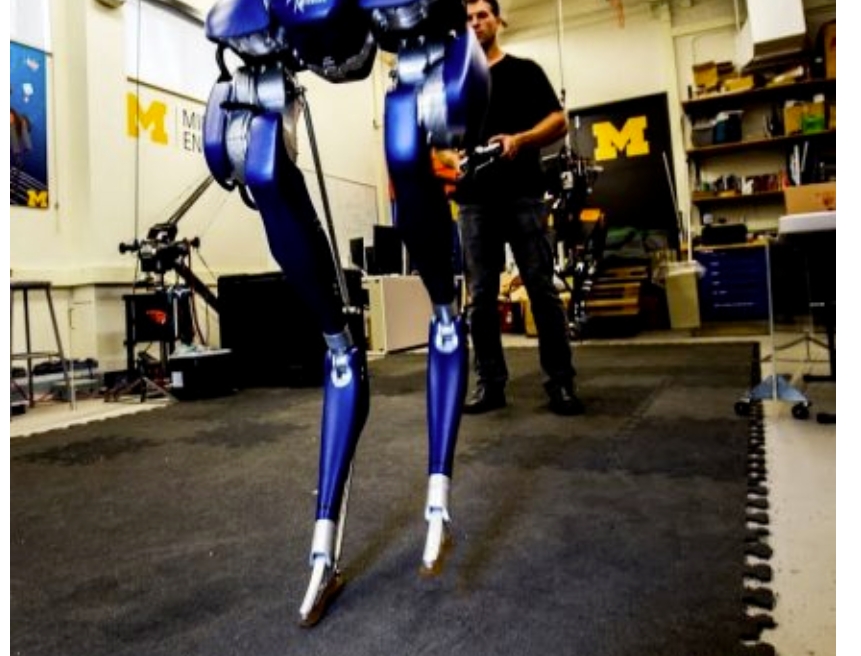
Bionic robot researchers believe that the bionics of the goat's feet and its gait are sufficient to support the development of bionic robots that can move on various rough terrain.
Bionic robot, the perfect fusion of biology and machinery
Robots are usually deployed in areas that are inaccessible or dangerous to humans. In these places, humans cannot intervene much with robots, so bionic robots have emerged. Compared with ordinary robots, bionic robots are generally more flexible and easier to adapt to complex environments.
Throughout the history of the development of bionic robots, from the early imitation of biological shapes, to the imitation of actions, to the use of sensors and data fusion technology to make correct judgments and reactions to changes in the environment, so as to adapt to changes in the environment, is gradually moving towards intelligence. So how do bionic robots learn animal movement characteristics, output data to verify their performance, and obtain feedback from pose data?
A simple and effective way is to use motion capture scheme. The 3D motion capture system can accurately capture the motion posture of biological and bionic robots to verify the accuracy of sensor data fusion and attitude estimation algorithms.
Break down technical barriers and meet the specialized needs of multiple fields
From a technical perspective, 3D motion capture is mainly developing in two directions, namely optical motion capture and inertial motion capture.
The optical motion capture has a wide range and clear spatial position relationship of the captured object, high accuracy and small error, and the data-driven agent based on optical motion capture can generate highly coordinated actions, which can provide physical interference when combined with physical simulation. Environmental changes and morphological differences respond to natural processes, making it suitable for many scenarios in the field of robotics, including unmanned swarm systems, exoskeleton robots, bionic robots, robotic arms, and other fields.
And with the continuous innovation of motion capture technology, more motion capture systems have been developed for specific research scenarios, such as underwater optical motion capture systems, which have strong application potential in marine and underwater robot research.
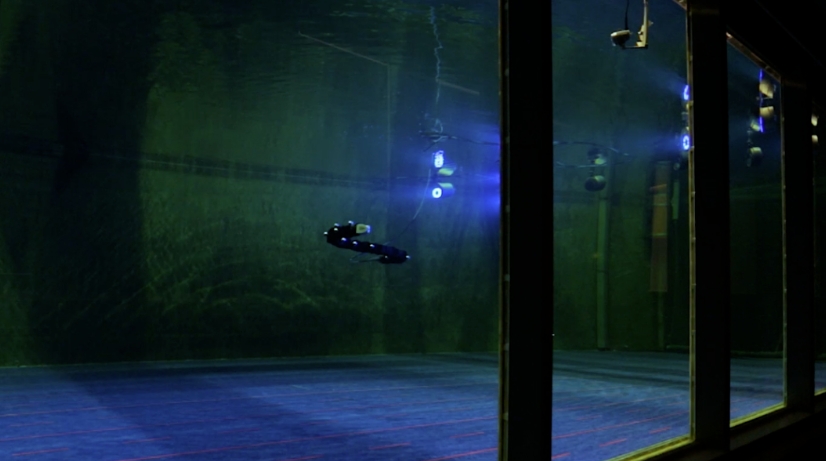
The birth of the underwater optical motion capture system provides powerful data support for the accurate testing of the motion trajectory, spatial position, and range of activities of the underwater robot, as well as the establishment of a three-dimensional model, and the real-time monitoring of the motion ability, motion mode, and motion law of the underwater robot. At the same time, it is also convenient for designers to intuitively judge the motion ability, motion mode, and control effect of the underwater robot.
In the application of robots, compared with the traditional remote control method, the optical motion capture system can realize more intuitive, detailed, complex, flexible and fast motion control, thus improving the robot's ability to cope with complex situations. In the current situation where the fully autonomous control of robots is not yet mature, this technology is of great significance.
Qualisys motion capture system has high-precision positioning capabilities indoors, outdoors, and even underwater, and can provide detailed spatial position information for various types of robots. It is often used in algorithm verification, motion planning, human-machine interaction, trajectory playback, gait analysis, intelligent sand table, and other robot research.
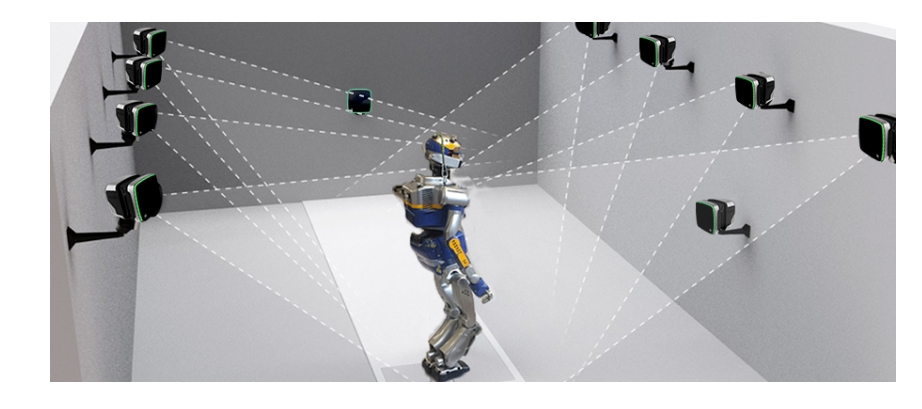
Motion capture systems are widely used in the field of robotics
For the robot arm used in industrial manufacturing line, logistics and warehousing scenes, the motion capture system captures its modular robot arm and dexterous hand to obtain its attitude data, and can carry out corresponding control planning;
For multi-legged robots that can be used in earthquake relief and military scenes, the motion capture system optimizes its motion mode in different environments by capturing the joint angle and speed information of its feet;
Disabled people and special soldiers are equipped with exoskeleton robots, which can obtain kinematic gait information such as joint angles with the assistance of a 3D motion capture system, which can optimize the exoskeleton structure and better assist the wearer in various aspects.
Bionic robots need to combine the characteristics of practicality and physical appearance, so every detail of bionic robot movement is important.
Optical 3D motion capture systems are playing an increasingly important role in the field of automated scientific research: among the 1949 papers in ICRA in 2, 688 used optical 3D motion capture systems (35.3%), an increase of 75 compared to 2020; among the 1943 papers in IROS in 2, 625 used optical 3D motion capture systems (32.2%), an increase of 68 compared to 2020.
Based on its accuracy, real-time and flexible applicability, 3D motion capture systems provide strong support for disciplinary research and industry applications in the field of automation control, helping automation control to take a breakthrough step towards intelligent control.



 The browser own share function is also very useful~