This issue will share with you an academic paper using PressureFilms pressure sensing paper to collect experimental data. The research involves footprint inspection, morphology and other fields. Thank you, Mr. Zhang Enwei of Liaoning Police College, for authorizing the sharing!
Abstract:
[Objective] Factors such as the increasing variety of shoes and the frequent personal flow of criminals discarding the shoes after committing crimes are the main reasons restricting the role of footprints in case detection. It is urgent to solve the problem of "different shoes on the same foot" in footprint inspection and identification.
[Methods] The plantar pressure distribution was extracted by stress testing paper, the characteristics were extracted by morphological analysis, and then the samples and samples were tested by clustering and principal component analysis.
[Results] The red footprint pressure map and leather shoe footprint pressure map of A and B can be well classified in the software, and the test dust shoe print can fall into the preset partition.
[Conclusion] This method can well distinguish whether the flat dust shoe print is left by the suspected foot, and realize the inspection and identification of the footprint of "different shoes on the same foot".
Key words: stress testing paper; footprint test; morphology
CLC number: D918.91
Document identification code: A
Article number: 2096-0727 (2024) 01-0094-06
Article interception:
With the continuous development of criminal science and technology, fingerprints, DNA, portraits and other technologies are equipped with automatic identification information systems based on human biometrics. The use of the above automatic identification systems to carry out case investigation and suspect pursuit has achieved remarkable results. The footprints of different people The biological characteristics of the human body also have certain regularity and relative stability, but the automatic identification of "different shoes on the same foot" is not realized, only the automatic identification of the shoe print pattern is realized. Stress testing paper can test the matching pressure of parts, and its application to footprint inspection and identification can intuitively reveal the footprint pressure points and pressure surfaces. This paper attempts to explore a scientific and effective method of using stress testing paper to reveal the pressure points and pressure surfaces of footprints, and to explore the correlation between pressure and sole rubber loss and dust shoe print, so as to solve the problem that footprints left on site will not lose their evidentiary value with changing shoes.
Stress testing paper, also known as pressure-sensitive paper and pressure-sensitive film, is a special kind of paper whose coating can produce color changes or imprints according to external pressure. This kind of paper has a wide range of applications in many fields. In the medical field, stress testing paper is used in medical devices such as body temperature, blood pressure, and heart rate measurement, and relevant physiological parameters can be obtained by detecting and recording changes in pressure applied to the paper; in engineering and manufacturing, stress testing paper is often used to measure and analyze contact pressure distribution, for example, in hydraulic systems, stress testing paper is used to measure sealing performance and pressure distribution; in the field of art and design, stress testing paper is used by artists and designers for creation and expression, and unique textures, patterns, and color changes can be produced on the paper by applying pressure; in education and entertainment, stress testing paper is used in painting and writing teaching, and correct writing postures and gestures can be taught through touchpoint pressure; In the field of security and anti-counterfeiting, stress testing paper is used to make security seal labels and anti-counterfeiting products, and specific color changes or imprints can be triggered by applying pressure to ensure the authenticity and safety of the product.
The shape and structure of stress testing paper are similar to film, consisting of two pieces, transparent paper for dyeing and translucent paper for carrying. Many invisible microcapsules are densely arranged on the base of the carrying paper, and the capsules are filled with colorants. When used, the two pieces of paper are rough and placed flat on the ground after stacking for testing. Stress testing paper is divided into different types according to the pressure value, equipped with color cards, 0.3~ 1.30 trillion Pa is suitable for footprint pressure measurement.
When using stress testing paper, consider the temperature and humidity when applying pressure. Select the corresponding pressure density curve according to the temperature and humidity conditions to compare the standard color sample, identify the color density value, and find the corresponding pressure value. Stress testing paper is very sensitive. Do not press and rub before use. Long-term contact with the color-developing substances inside will cause skin allergies. It is recommended to wear gloves to operate, and at the same time prevent water, oil and other foreign objects from contaminating the stress testing paper.
Intercept of experimental part:
20 experimental subjects were randomly selected, each of whom walked normally on PressureFilms stress testing paper, extracted 4 naked footprints with the same foot and 4 leather footprints with the same foot. The footprints were magenta, and the images were entered into the computer with a scanner. The resolution was 300 pixels, and the scale and color card were placed when scanning.
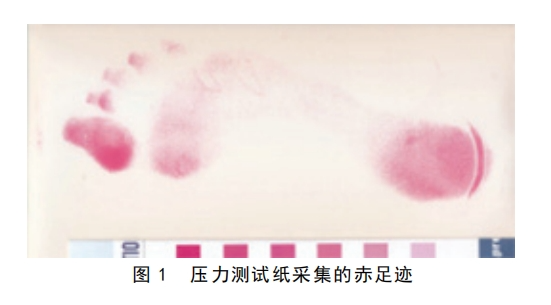
On hard ground, the red footprint collected by the stress testing paper only shows the image of the compressed area, the overall range of the footprint is reduced, and the arch area is lightened, unlike the ink print, which also shows the slight pressure area on the edge. The trailing edge of the footprint shows a knock mark, and the heel area shows a strip-like shading phenomenon from the back to the front, reflecting the rolling of the force when the foot is dynamically dropped. The heavy pressure areas appear in the plantar area, the first plantar area, the fourth toe, the small toe, and the second plantar area in sequence, and the front edge of the plantar toe and the second toe shows a crease mark, as
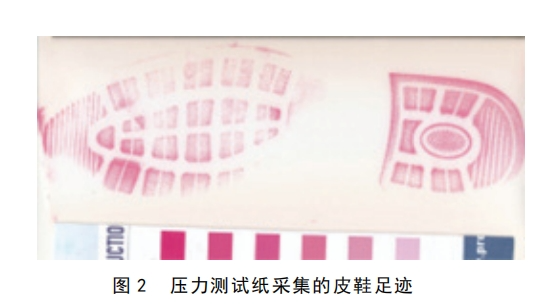
On the hard ground, the edge of the shoe footprint collected by the stress testing paper appears intermittent, the overall range is smaller than that of the ink collection, the internal pattern is lighter, the color depth of the area changes significantly, and the heavy pressure area is obvious. This is the key to the superiority of the stress testing paper over the ink collection, as shown in Figure 2.
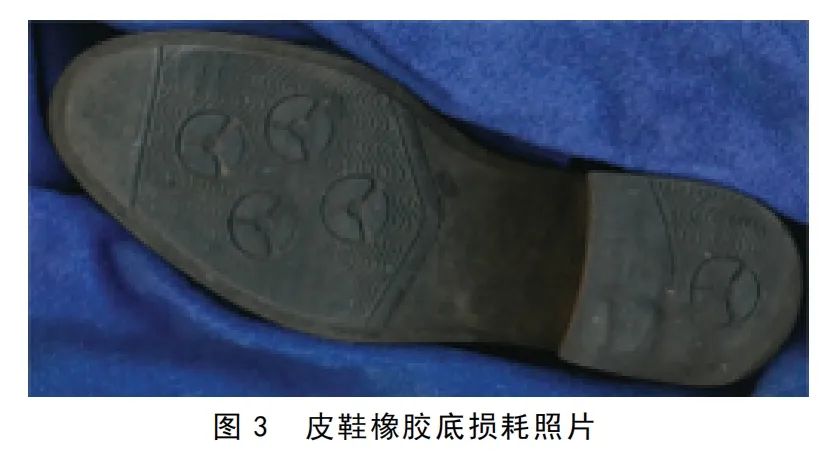
Sole rubber loss is divided into extrusion loss and friction loss. Extrusion causes vertical fracture-like loss to the sole pattern, and the pattern becomes thinner, but the pattern lines still exist; friction causes lateral cut-off-like loss to the sole pattern, and the pattern disappears completely, which will smooth the area, as shown in Figure 3.
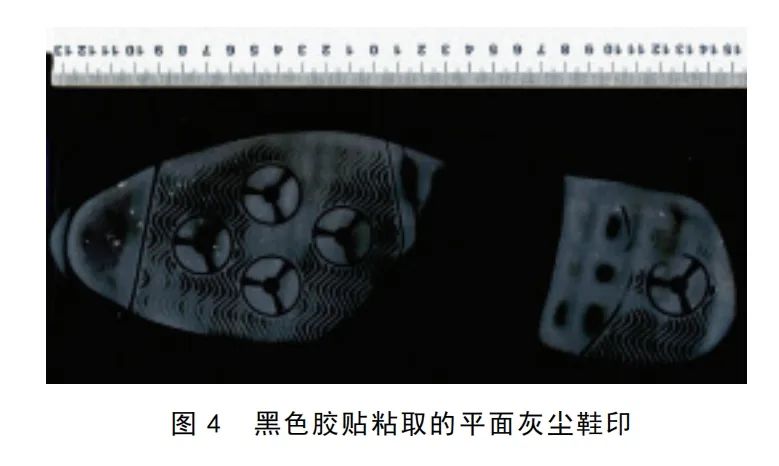
The discriminant analysis of the rubber loss area of the sole mainly looks for the area formed by vertical extrusion, because the direction of the force in the collected barefoot and leather shoe pressure maps mainly comes from vertical extrusion. The extraction of the flat dust shoe print on site is made of black glue, and the leading edge of the hallux area is clearly visible, as shown in Figure 4.
Conclusion Intercept:
This experiment validates the feasibility of using stress testing paper to visualize the plantar pressure distribution and analyze the dynamic morphological characteristics of the footprint. The footprint pressure can be visualized and quantified by a specific vector. Trace characteristics can be identified by a computer or trace expert, and each feature is represented by its feature vector (feature type, orientation, position/shape relative to nearby features). Applying stoichiometry to trace evidence identification, the most challenging part is the correct comparison of the amount of change that occurs naturally (i.e. distortion) with the amount of change that might be expected in the relevant population describing the non-matching source, and conducting exploratory experiments. Due to limited funding and limited experimental data, only a verifiable summary of the method is made. In the future, the number of samples and materials should be increased, especially the flat dust shoe prints extracted on site, and the pressure area discrimination method should be verified with more data. This method provides a new idea for collecting the footprints of criminal suspects in the front line of public security, expands a new method for footprint inspection, and makes a preliminary attempt to improve the efficiency and accuracy of footprint identification.
The copyright of this paper belongs to the original author. Contact Shanghai Fengyou Biomechanics R & D Center http://delsys.online/Zz_bio.omgl.com.cn_all/about.html get the full paper.



 The browser own share function is also very useful~